A city break in Transylvania’s towns is never a bad idea. But a city break in Sibiu is almost always the best option – whether you’re coming from the east or the west.
AT A GLANCE
How long: 2 days for the old town; add half a day for the ASTRA Open-Air Museum, 4 km from the center.
Don’t miss: the Large Square (Piața Mare), the Small Square (Piața Mică) and Huet Square, the Brukenthal National Museum, the Bridge of Lies, the Evangelical Cathedral.
Heads-up: the Council Tower has been closed for restoration since January 2026, for about two years. The alternative: the Evangelical Cathedral tower – 192 steps and a viewpoint at 55 m.
Parking: paid daily from 8:00 to 22:00, weekends included; 3 lei/hour (about €0.60) or 15 lei/day (about €3) in the center, 1.5 lei/hour outside it.
Getting around: the center is best explored on foot; a bus ticket costs 3 lei, valid for one hour – pay by card on board.
Where to stay: book early if you’re coming for FITS (the Sibiu International Theatre Festival), Artmania or the Christmas Market – the city fills up.
Local tip: the best tripe soup (ciorbă de burtă) in town is at Kon Tiki.
Updated: October 2026
In Sibiu things are fain (the local word for “nice”), people drink their cafia (”coffee”) slowly, and nobody seems in a rush to be anywhere. That’s what most visitors discover after a day or two here. The city has its flaws too and we’ve experienced them firsthand, having lived here for nearly ten years. But in this article we’re focusing on what Sibiu has to offer as a destination, and why it deserves a spot on your Romania itinerary if it isn’t there already.
In other words: if you’re driving from Chișinău, why stop only at Brașov when Sibiu is worth the extra kilometres. Or if you’re coming from Timișoara, why it’s worth stepping out of the shadow of those grand historical buildings and coming to watch the sunset between the “eyes” of the old Saxon houses in Sibiu’s historic centre.
Contents

Sibiu: a little context
The city of Sibiu – known in German as Hermannstadt – has a fascinating history. If you’re not yet familiar with its past, history is still alive at every corner here: the walls, the squares, the towers and the monuments are the imprint of nearly 900 years of existence (the city’s official founding date is 20 December 1191, the date of its first historical record).
In the 17th century, Sibiu served as the capital of Transylvania, which was then a grand principality within the Habsburg Empire, and as the residence of the Governor of Transylvania. (One of those governors was Samuel von Brukenthal, the only Transylvanian Saxon to reach such a high position. With a touch of irony, the next person of Saxon origin from Transylvania to reach a comparable office was Klaus Iohannis in 2014. For the Saxons of Transylvania, however, this kind of representation at the highest level mattered greatly, which is why Iohannis’s name can even be found in a children’s book published in Sibiu.)
In Sibiu, you’ll frequently hear that the city was the first in Romania at almost everything – and the locals take unmistakable pride in saying so. The city’s own municipality website lists the first school, the first library, the first hospital, the first pharmacy, the first Romanian-language medical book, the first theatre building, and the first cast-iron bridge on what is now Romanian territory, all as Sibiu firsts. Locals still speak with pride about 2007, when Sibiu was the first Romanian city that held the title of European Capital of Culture – even though nearly 20 years have passed. Nothing of comparable scale has happened since, except perhaps the EU Leaders’ Summit in 2019. It’s also worth mentioning that the city has received two more titles since then: European Gastronomic Region (2019) and European Capital of Hiking (2021) – though little tangible legacy has remained from the first title, while hiking continues to be promoted at county level.
But let’s come back to the present and walk through the most important sights Sibiu has to offer.

A city break in Sibiu starts with Piața Mare, Piața Mică and Piața Huet
We’ll start where any visit naturally begins – the heart of the historic centre. Because Sibiu isn’t a large city, two days are enough to discover it and fall for it. Any short visit will revolve around the historic centre, and the three main squares – Piața Mare (the Large Square), Piața Mică (the Small Square) and Huet Square – will be your main points of reference.
Piața Mare / The Large Square

Home to what was once a “madman’s cage” (more on that below), and today to one of Europe’s finest Christmas markets.
The square dates to 1366, when the third ring of the city’s fortifications was completed. In the early 1400s it was documented as a grain market, and by the mid-15th century the first buildings had begun to appear around it. During the Middle Ages the square hosted public gatherings and executions. Between 1724 and 1757, a “cage for madmen” (Narrenhäusel in German) was placed here, where those who disturbed the public peace at night were put on display during the day. In 1757, it was moved to Piața Mică / The Small Square.
During the period of Greater Romania, the first athletics competition on Romanian soil took place here. Under communism, the square was turned into a park. In 1984 the park was removed, and two years later an imposing statue of scholar Gheorghe Lazăr – founder of Romanian-language education – was installed, sculpted by Radu Aftenie. In 2005 the square underwent another renovation; in 2006 the statue was replaced with a smaller-scale version by the same sculptor (the original was restored and placed in Avrig, Lazăr’s birthplace, in September 2023). The square was repaved in granite and stone, and the iron-grille fountain was restored.
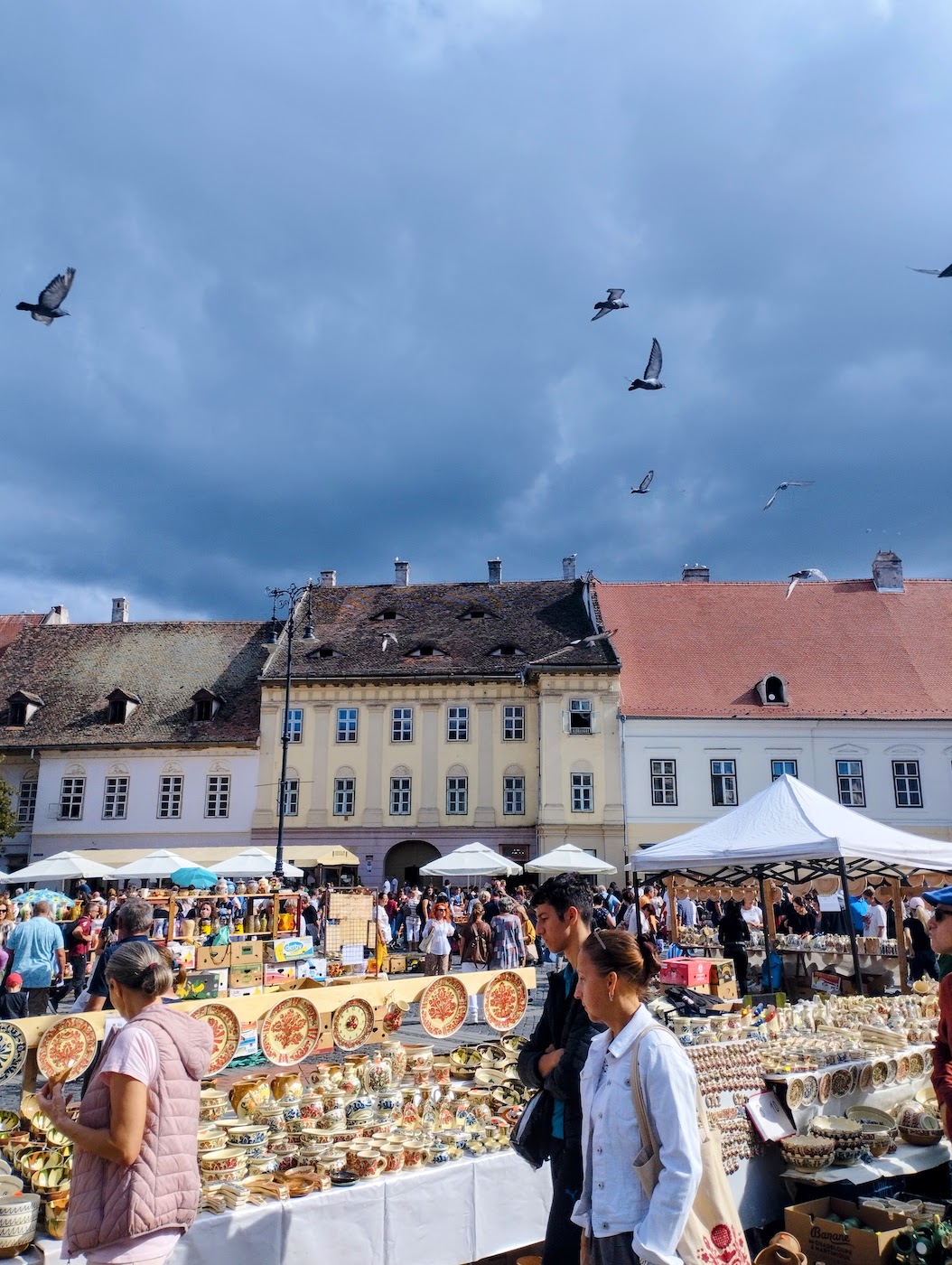
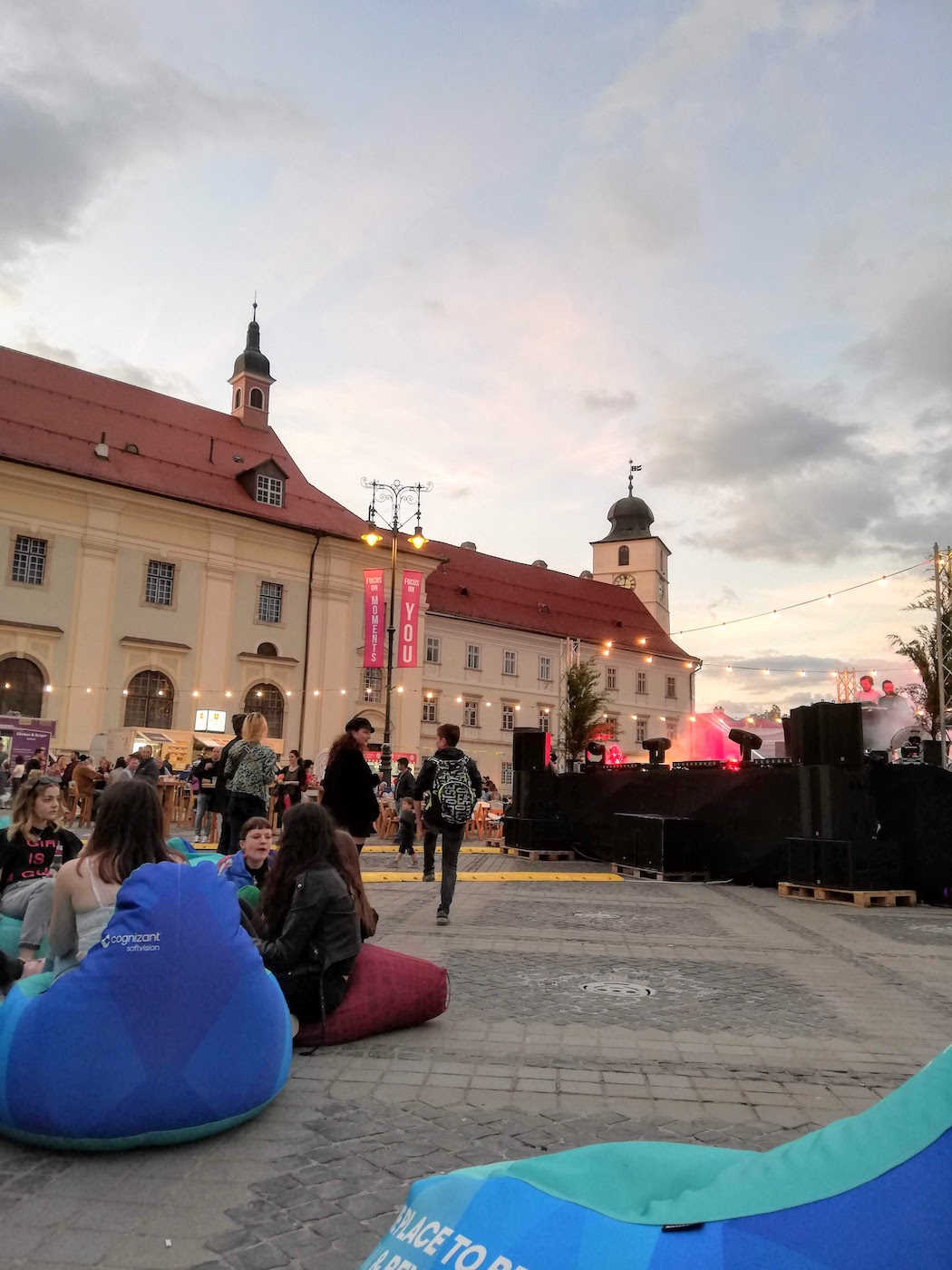
Today, the Large Square is the city’s main stage – festivals, concerts, and the famous Christmas Market all happen here. In quieter times, the terraces draw visitors looking to linger, while locals use it as an everyday meeting point.



Piața Mică / The Small Square
The square began to take shape after 1350. Today it preserves, with few changes, the appearance it had in the 15th and 16th centuries – all its buildings are listed historical monuments. The tall facades feature those distinctive dormer windows known as the “Eyes of Sibiu.” This is also where you’ll find the famous Liar’s Bridge, completed in 1859. After buildings on the street were demolished in 1851 and the road was laid out, a wooden bridge connected the two parts of the square (see below).


Piața Huet / Huet Square
In my opinion, this is one of the most picturesque places in the city – and our personal favourite spot in the historic centre. Dominated by the imposing Gothic Evangelical Cathedral, renowned for its remarkable acoustics and magnificent organ, the square is a cultural and historical hub. This is, in fact, where Sibiu’s history began.
The square formed around the city’s first fortification, dating from the late 12th century. The buildings display a mix of Gothic, Renaissance and Baroque architecture. It was an important centre of the Saxon community – their wealth and influence in the city was visible here. The name comes from Count Albert Huet, who installed a church and school library here in 1592. Over the centuries the square has been transformed several times, and today it’s a pleasant public space with shaded benches, a few cafés and craft shops. Every Friday a small farmers’ market takes place here – known locally as „Vinerea Verde” (Green Friday) – and various festivals are also held in the square.


Historic buildings in Sibiu
Every building in the historic centre has a story, but we’ll focus on the most significant ones – architecturally and historically.
The Brukenthal Palace (or the Brukenthal National Museum) is without question the building-institution that impresses most and must be visited. It was built between 1778 and 1788 by Samuel von Brukenthal, Governor of Transylvania, to designs by a Viennese architect named Joseph Franz Martinelli. You’ll find it on the Large Square, directly across from City Hall. Detailed historical information is available on the Sibiu heritage website. Important to mention: the Brukenthal Museum is the first museum on what is now Romanian territory, opened here in early 1817, when Samuel von Brukenthal’s art collections were made public.
Its collections are extraordinary: books, paintings, tapestries, period clothing. The masterpieces include “Man with a Blue Cap” by Jan van Eyck, “Ecce Homo” by Titian, “Head of a Child” by Paolo Veronese, and “Portrait of a Man Reading” and “Portrait of a Woman in Prayer” by Hans Memling.

Filek House: Few people know this, but at the opposite end of the Large Square, diagonally across from the Brukenthal Palace, a master tanner tried – a few decades later – to build a replica of it. Today the building houses the Superior Consistory of the Evangelical Church in Romania and the Honorary Consulate of Austria. The tanner’s name was Anton Filek, and he had the money to build a palace. If you look closely at the Brukenthal Palace, you’ll realise he didn’t quite pull it off. The building does have Baroque touches, but it represents the transition to the modern era.


Hermes House is a distinctive building on the Small Square that breaks away from the typical “eyes” houses. Its neo-Gothic style, unusual stepped gable facade with small turrets, and balcony with balustrade all draw the eye. It was built between 1865 and 1867 as the headquarters of the Small Craftsmen’s Association. Until recently it housed the Franz Binder Museum of Universal Ethnography, opened in 1993, which was also home to Romania’s only mummy – now moved to the ASTRA Museum’s deposit.

Böbel House, dated to the 14th century, is considered by locals to be the oldest surviving residential house in Sibiu – and probably on the entire current territory of Romania. It stands at 16 Avram Iancu Street.

The Faculty of Theology at 20 Mitropoliei Street is a rare example of the neo-Brâncovenesc style in Sibiu, built in 1914. A commemorative plaque incorrectly states that the founding assembly of ASTRA (the Transylvanian Association for Romanian Literature and the Culture of the Romanian People) took place here on 23 October-4 November 1861. In fact, ASTRA was founded at 5 Nicolae Bălcescu Street – a historical inaccuracy still standing in plain sight.

The list of buildings in Sibiu is a long one and they’re best discovered on foot.
Fortifications and towers
Although Sibiu began as a village on the banks of the Cibin river, it grew into a fortified city – a settlement enclosed by walls. Fortification began in the late 12th century. The first ring was built around what is now Huet Square. As the city expanded rapidly and Ottoman attack became an increasing threat, second, third and fourth defensive rings were added, enclosing both the upper and lower town. These were later reinforced with bastions.
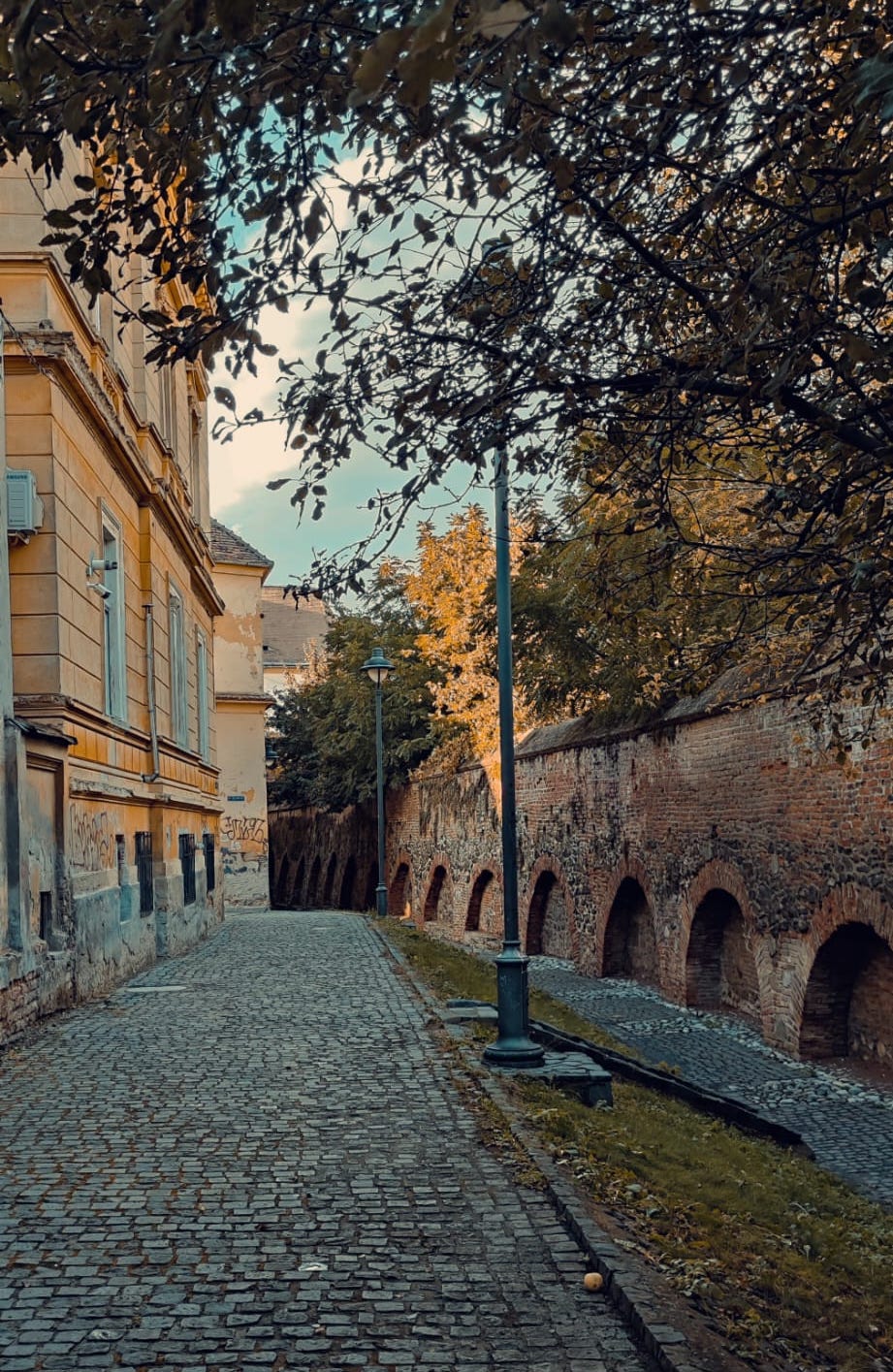
Today, substantial sections of the defensive wall are still visible around the historic centre. In many places the bricks have been replaced over time, but some stretches still look almost abandoned – or the restoration simply stopped mid-wall.

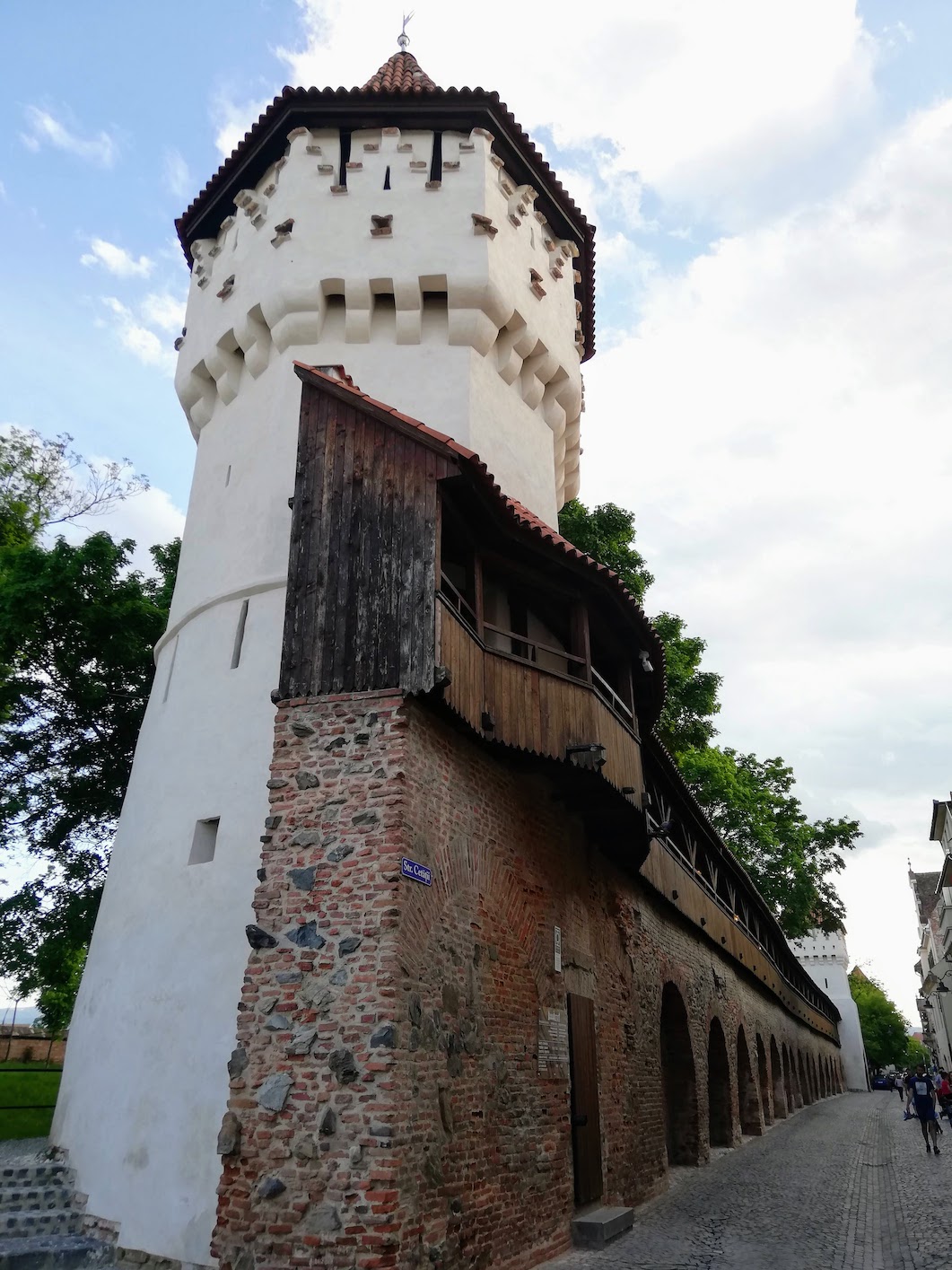
Still, a walk along the wall beside Cetății Park, with visits to the Carpenters’ Tower, the Potters’ Tower and the Arquebusiers’ Tower – all three restored in recent years – can transport you to another era entirely.
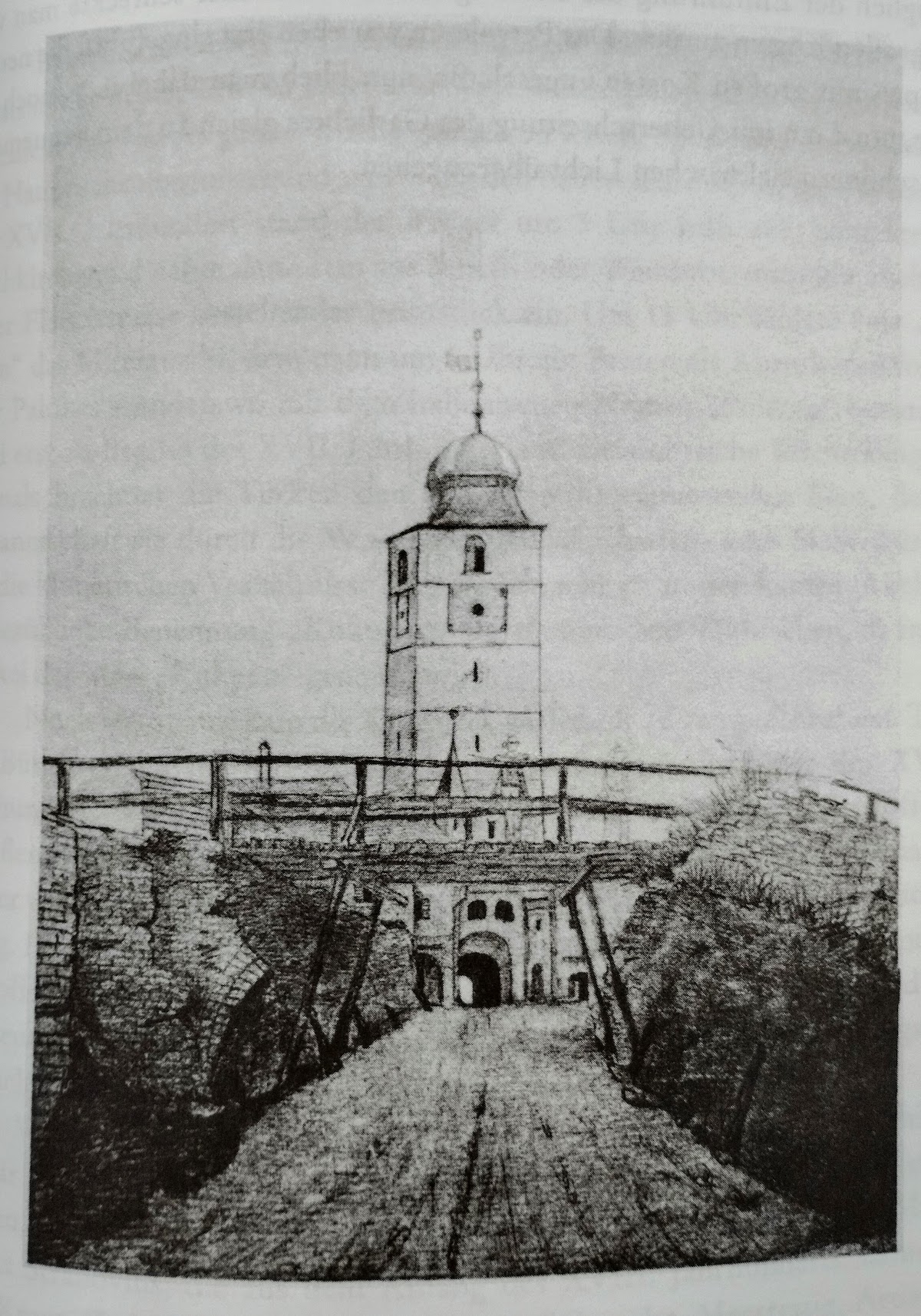
The Council Tower
The Council Tower is the most recognisable of Sibiu’s surviving towers and one of the city’s most iconic historical monuments. It stands between the Large Square and the Small Square, and has always been the defining symbol of Sibiu. Its name comes from its role guarding the gate into the second fortification ring, close to the building that housed the city hall, first documented in 1324. The tower itself is believed to date from between 1224 and 1241. In its current form it rises seven progressively receding storeys.

Visitors can climb all the way to the top, where the red rooftops against a backdrop of mountain peaks made for a memorable view. Entry is free for children; adults pay 4 lei (less than €1). At least, that was the case until last year (2025).
Note: From January 2026, the Council Tower is closed to visitors for two years of renovation works.


The Liar’s Bridge
The Liar’s Bridge is one of Sibiu’s most recognisable symbols. Rebuilt in 1859, it replaced an earlier wooden bridge.
Numerous legends explain its name. It is the spot most sought out by tourists. Since 2012–2013, love padlocks have appeared on its railings, though they are periodically removed by the local authorities. Local historians consider the padlock tradition “banal, far from original, and even dangerous.”

The Holy Trinity Orthodox Cathedral
The Orthodox Cathedral dedicated to the Holy Trinity was built between 1902 and 1906 by architects Virgil Nagy and Iosif Kamner from Budapest. It is modelled on the Byzantine basilica style – a reduced-scale replica of the Hagia Sophia in Constantinople. Its towers reach 45 metres.

Octavian Smigelschi, one of the most celebrated Romanian artists in Transylvania, painted the dome, the pendentives, the evangelists and the iconostasis. His work is extraordinary – it calls to mind Michelangelo’s sculptures or at least the Italian Renaissance, while incorporating distinctly Romanian elements. Smigelschi’s contribution was considered “scandalous” in its time precisely because he had “Romanianised” church painting.

The Evangelical Cathedral
The Evangelical Cathedral is one of the most impressive Gothic buildings in Transylvania. It was built in the 14th century on the site of an earlier church dating from the 12th century. The building is dominated by a seven-level tower with four corner turrets. The tower is reached by climbing 192 steps, which end at the four turrets offering a panoramic view of the city. The viewing platform sits at 55 metres. The tower houses three bells and stands 73.34 metres tall – the highest structure in Sibiu.

From 1496, for a period of 300 years, the church served as a burial place for mayors, counts and other prominent citizens. In 1796, burials inside the church were prohibited, though one exception was made in 1803 when Baron Samuel von Brukenthal was laid in the crypt beside the pulpit. In 2025 there were local discussions about opening the tomb to confirm his remains were actually there – the church refused, and the matter was put aside.
The legend of the tower’s height: apparently the race to build the tallest tower was not unique to Sibiu. The story goes that the Sibiu Saxons, wanting their church tower to be the tallest, sent a delegation to the Saxon community in Bistrița to measure their tower with a rope. That evening, the Bistrița craftsmen invited the Sibiu delegation to a feast and, while getting them drunk, secretly cut a length off the rope. As a result, the tower in Bistrița remained the tallest in Transylvania at 75 metres.
Thalia Hall (State Philharmonic)
Thalia Hall – or the Sibiu State Philharmonic – is a culturally significant building that is technically in need of investment. It was built in 1787 by Martin Hochmeister, the founder of the country’s first bookshop, and is a genuine architectural gem, featuring two balconies and a box reserved for the Governor of Transylvania.

The building occupies the Thick Tower of the city’s fortifications – one of the few spaces where a theatre could be set up. And unlike its current function as a concert hall, Thalia Hall was originally designed for theatrical performances. The first show took place in June 1788. The poet Mihai Eminescu himself was here in 1867 as a prompter with Mihai Pascaly’s troupe – the first time a performance was given in Romanian in this hall.
The building suffered heavily in two fires, in 1826 and 1949. Restoration began in 1990 and was completed in May 2004. The first concert in the restored hall took place on 29 May 2004, with Beethoven’s Ninth Symphony.
The ASTRA Open-Air Museum
The ASTRA Museum is fascinating – both for its uniqueness and for its sheer scale of 96 hectares, of which the exhibition itself occupies 42. It is the largest open-air museum in Europe, and if you’ve had enough of cobblestones, asphalt and cut stone, it is a genuine must-see on any Sibiu city break.

The story of ASTRA Museum begins more than a century ago, when Romanians in Transylvania began realising a dream: to organise in Sibiu, under the aegis of the Association for Romanian Literature and the Culture of the Romanian People, a collection showcasing the most representative aspects of Romanian life. The first exhibition of the Association’s Museum – from which the name ASTRA derives – was held in 1905.
The museum is located about 4 kilometres from the city centre, in the “Dumbrava Sibiului” nature reserve. Here, nature and culture blend harmoniously in a true village of Romania: 10 km of paths take you through peasant homesteads, craft workshops, small wooden churches, wayside crosses, sheepfolds, water mills and windmills. The original interiors, remarkably well preserved, tell the story of simple rural life and invite you to think about old skills and how they might be rediscovered.
In summer, the museum comes alive with numerous events.
City break in Sibiu: Where to stay
In 2023, Sibiu was the only Romanian city outside Bucharest to open a new hotel – the Mercure Sibiu Arsenal. The need for accommodation is still significant, especially during major events such as the International Theatre Festival, the Christmas Market, or Artmania – everything is fully booked. Outside those periods, finding a place to stay is easy, and the city suits all budgets: from 3- and 4-star hotels (and one 5-star) to guesthouses and hostels.
The accommodation offer extends to the villages immediately surrounding the city – Șelimbăr, Cisnădie and Cisnădioara, Rășinari, Șura Mare, Șura Mică, and Ocna Sibiului all have options if the city itself is full.
For those wanting to stay in the heart of the historic centre, Casa Generalului and Hotel Am Ring both offer views over the Large Square. (We recommend these, because we also stayed here and we know it was good – though of course the options don’t stop there.)
Parking in Sibiu
Most parking spaces in Sibiu are paid, even on weekends, between 08:00 and 22:00. Rates vary by zone: from 1.5 lei/hour outside the historic centre to 3 lei/hour within it, or 15 lei/day. Spaces are clearly marked. (Note: 5 lei = 1 EUR)
Parking in residential courtyards is currently still free, though the city is discussing whether to introduce fees there too, with the possibility of annual resident permits.
There are also several larger car parks with barrier systems:
Cazarma 90 (map): 205 spaces. Rate: 3 lei/hour.
Piața Teatrului (map): 160 spaces. Rate: 3 lei/hour.
Hipodrom III multi-storey (map): 319 car spaces + 22 motorcycles + 33 bicycles. Lower levels reserved for residents; ground floor and roof terrace open to visitors. Rate: 1 leu/hour.
Electric vehicle charging is available. The ElMotion app shows available (and working) charging stations, or you can find the information here.
City break in Sibiu: Getting around
The best way to get around Sibiu is on foot. The city is compact and easily walkable, especially in good weather.
Cycling is also comfortable, despite the infrastructure not yet being fully developed. There are several bike-sharing stations around the city – Sibiu Bike City. Download the PBSC app (Android / Apple) and you can ride for very little: 1 leu/hour or 10 lei/day for occasional use, or 20–40 lei for 20–40 hour subscriptions. Bikes are not available in the cold months.
Public transport is another good option. In recent years the fleet has been renewed, providing greater comfort. A Green Line of electric minibuses operates around the historic centre. The fare is 3 lei, valid for one hour. Card payment is accepted on all buses.

Where to eat in Sibiu
There’s no shortage of options – it depends on your appetite and your expectations. We’ll publish a dedicated food article with more recommendations, but here’s a quick overview:
For a special culinary experience in the centre: Kulinarium, Jules, La Cuptor, Ribs & Beer, La Arhive.
If you don’t mind stepping outside the city walls: Crama Ileana and Dobrun (both traditional Romanian food, tasty and affordable), Kombinat Gastro-Brewery, Turtha Sweet & Savoury (which has also opened a branch on the pedestrian Nicolae Bălcescu street), Joyme Pub.
For something a little more exotic after enough smoked pork and stew: A Camponeza – Casa Gastronomului, a Portuguese restaurant we recommend with confidence.
For a good beer on a warm evening: Scottish Pub without hesitation, or Butoiul de Aur (at above-average prices).
For fast food: try Dabo Döner – a local franchise with an excellent product.
And finally: while you’re in Sibiu, don’t miss the ciorbă de burtă (tripe soup). Not just anywhere though – we firmly recommend Kon Tiki. You won’t regret it. Their tripe soup is sought out equally by white-collar workers and construction crews. That’s usually a reliable sign.
Relax
If you’ve had enough sightseeing and want to relax, head to Baia Populară (the Sibiu Public Bath) – which holds the unofficial title of “Romania’s oldest spa.” It’s not a joke: the historic public bathhouse building was restored and transformed into a spa and wellness centre, and it’s become a genuine local institution. Booking online in advance is recommended, though you can also pay at reception subject to availability.
Entry costs 30 lei per adult for one and a half hours at the pool, or 55 lei for three hours with pool and sauna. Full rates and booking information are available here.

Near the airport, the Aria Sibiu complex offers a modern aqua park, spa and fitness centre with a range of facilities.
For families with children, Playtopia – promoted locally as “Romania’s largest themed entertainment park” – is an excellent destination packed with activities and games.